By Ben Esposito, Professional Golfer & Founder of In The Golf Zone
Many golfers may have looked at their wedges and wondered what the mysterious number is under the loft; others have most likely completely ignored it. That number is the degree of bounce and is actually an important part of understanding how your wedge works.
Most golfers have heard the term before, but very few actually understand what it does or how much it can affect contact, consistency, and confidence around the greens.
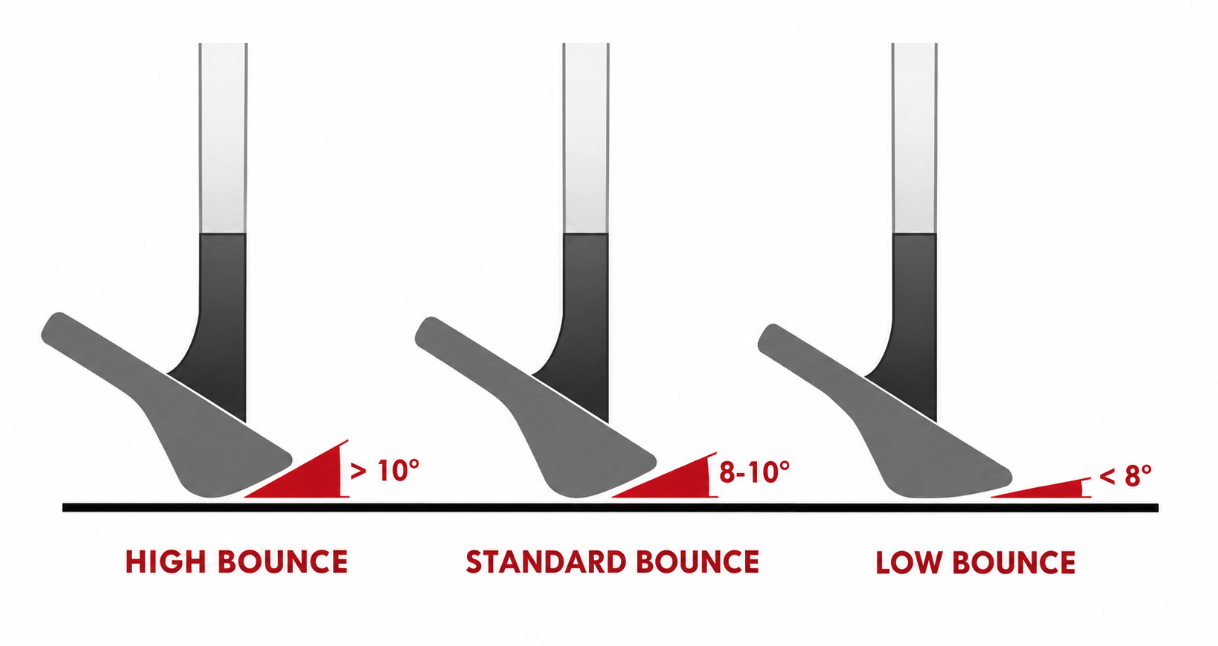
Bounce is the angle between the leading edge of the wedge and the lowest part of the sole. When that angle is higher, the sole sits lower than the leading edge and helps the club resist digging into the turf or sand. When bounce is lower, the leading edge sits closer to the ground and allows the club to cut into firmer conditions more easily.
You can often even visually see higher bounce wedges protruding more underneath the club.
While bounce tells golfers how much the club resists digging, grind refers to how the sole of the wedge is shaped. The grind is indicated by a letter under the loft. Different grinds change the way the club interacts with the turf and sand, especially when opening or closing the face around the greens. Grinds can also influence the way a player utilizes the bounce.
To make a grind, manufacturers remove material from different parts of the sole, including the heel, toe, and trailing edge, to create wedges that perform differently for certain shot types. The term “grind” dates back to when fitters and club builders used a metal grinder to shape each club by hand.
Many tour players carry multiple bounce types of the same lofted wedge. For example, a player may have three 60-degree wedges, all with different grinds and varying levels of bounce. (I will explain what the grind is below as well.)
Here is an outline of situations that are better for high and low bounces.
High bounce
- Thick rough
- Fluffy, soft or fine sand (especially when it is dry)
- Sandy turf
- Pine straw
- Softer turf
Low Bounce
- Fairway and tight lies
- Firm, wet or clay based sand
- Dry or firm ground
- Clay based soil or hard pan
- Firm or links style turf
Different manufacturers all use different letters to represent grinds. So there is no direct standard for grinds across brands. I (and many others) refer to grinds in terms of what they are for Vokey wedges, as Titleist was the first to popularize a wide range of grind options with the public.

For example:
- Wider sole grinds are typically more forgiving and perform well in softer turf and sand.
- Vokey K Grind (or similar Callaway W, Cleveland Full) – very wide sole, extremely forgiving
- Grinds with more heel and toe relief allow golfers to open the face more easily for flop shots, bunker shots, and creative short game shots.
- Vokey M Grind (or similar Callaway C, Ping B) – versatile grinds, commonly used by players who manipulate the face around the greens.
- Lower bounce “tour-style” grinds are often preferred on firm turf because they allow the leading edge to sit very close to the ground.
- Vokey T or L Grind (or Similar Callaway T, Ping T Cleveland Low) – low bounce, aggressive relief grind designed for tight lies and usually tour level players
Grinds can also have situational uses, but are also often player preference dependent. Getting the right bounce isn’t one-size-fits-all. Matching your wedges to your delivery, preferred shots, and the type of turf you predominantly play on can do wonders. In fact, sometimes better performance on different types of turf comes from bounce adjustments rather than technical changes.
For more information on how to utilize your wedges or play closer to your best more often in tournaments, please reach out to me at ben@inthegolfzone.com. I am a mental golf and performance coach who has helped players remotely in 25 states.
_________________________________________________________________________________________________________________________________________
I work with my students on identifying their best as well as offering personalized mental golf coaching that holistically combines mental game techniques, short game and course management.
I’m offering a FREE first consultation (sign up here) with no obligation. In the consultation, we will discuss my personalized coaching as well as answer any questions players and parents may have. Parents are encouraged to attend and everyone always learns something.
Visit inthegolfzone.com to learn more about me and how to take your game to the next level.
Ben Esposito
Professional Golfer | Founder of In The Golf Zone | Mental Performance Coach
407-704-0247 | inthegolfzone.com
ben.espositogolf@gmail.com Subscribe To The Free In The Golf Zone Newsletter Get The Latest In The Golf Zone Updates, Tips and Blogs!

Sources
us.dunlopsports.com/cleveland-golf
https://www.golfsidekick.com/wedges/sand-wedge-bounce-10-or-14-how-much-is-best