By Rex Grayner, SVP Business Development at the Hurricane Junior Golf Tour
Ten years ago, junior golf felt simpler.
Players showed up. They competed. Families drove home and talked about score.
Today, the environment is more layered.
Technology influences preparation. Recruiting timelines are clearer. Expectations are higher. And the weekend tournament experience has expanded beyond 36 holes.
If you have been around junior golf for a decade, you have felt the shift. If you are newer to it, this is the only version you know.
Here is what has evolved and what it means for families in 2026.
1. The Game Is More Data-Driven Than Ever
Ten years ago, most junior golfers measured progress with one number. Score.
Now the conversation is deeper.
Players analyze:
- Strokes gained trends
- Ball speed and launch windows
- Dispersion patterns
- Yardage gaps
- Scoring breakdowns by hole type
Technology from brands like Foresight Sports and Bushnell Golf have made high-level feedback part of everyday development, not just something reserved for college programs.
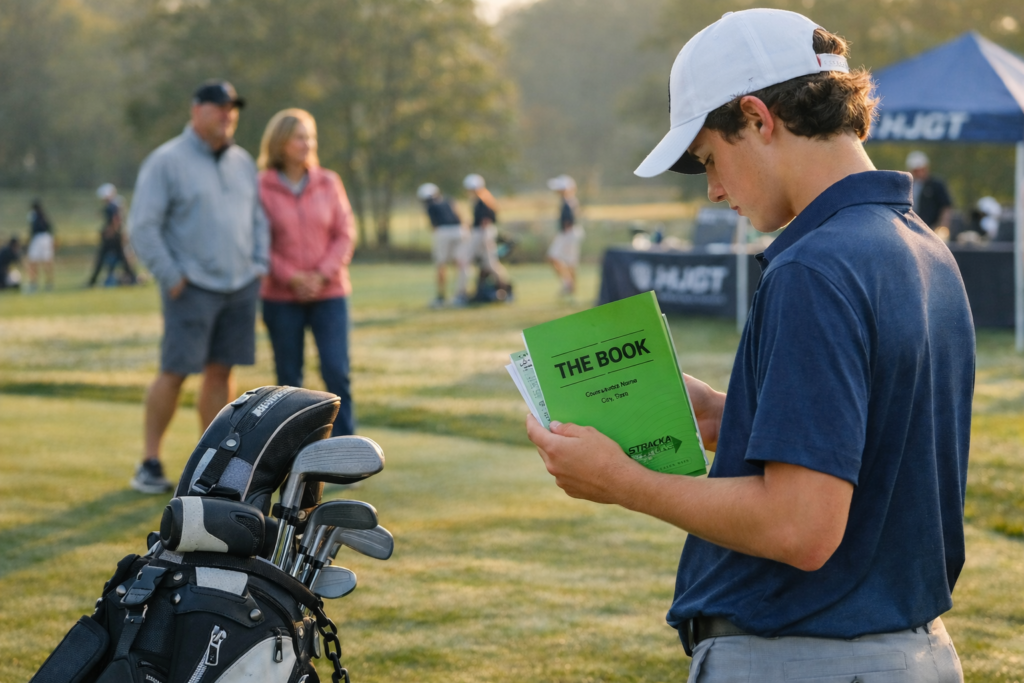
On the course, tools like StrackaLine yardage books have become standard for serious competitors. Players now walk into tournaments with precise green-reading data, slope maps, and detailed yardage information. That level of preparation changes confidence.
After the round, shot-tracking charts and tournament reporting tools help players see where strokes were gained or lost. Over the course of a season, those reports create something powerful. A documented development arc.
This matters in recruiting.
College coaches are not impressed by one hot round. They want evidence of growth. When a player can show a stack of validated tournament reports, green-reading preparation, and measurable improvement over time, it tells a much stronger story.
But here is the key.
Data is not the goal. Clarity is.
The players who use information to make better decisions. Those are the ones who separate themselves.
2. The Recruiting Landscape Is More Transparent and More Competitive
A decade ago, many families entered the recruiting process late and often uninformed.
Today, the calendar is public. The rules are clearer. Families understand quiet periods, contact windows, and official visit timing earlier.
At the same time, the competition has intensified.
In 2024 alone, more than 500 HJGT players signed or committed to play college golf. That number speaks to opportunity. It also speaks to the level of depth across the field.
Coaches now evaluate:
- Strength of schedule
- Performance consistency
- Academic alignment
- Communication maturity
- Evidence of year-over-year development
It is no longer about chasing one low round. It is about building a portfolio.
Families who understand this early make better choices about where to compete and how to communicate.
3. The Tournament Experience Has Expanded Beyond the Golf
This is one of the biggest shifts.
Ten years ago, the focus was almost entirely on the competition.
Now, the expectation is broader.
At the HJGT, we host more than 350 multi-day events annually, with over 20,000 registrations each year. 40-50% of the families travel and require lodging. For many, a tournament is not just a round of golf. It is a full weekend commitment.
The professional feel of an event is no longer defined by signage or logos.
It is defined by structure and utility.
- Clear yardage breakdowns by age group
- Staff presence on the course
- Defined pace-of-play standards
- Transparent communication
- Recognized ranking visibility
And beyond the golf, families expect a better overall weekend.
They want:
- Trusted lodging options
- On-site resources
- Brands that solve real problems
This is where youth sports has changed dramatically.
Brands are leaning into junior golf, not just for exposure, but because the audience is intentional. Education-focused. Travel-committed. Invested in development.
But logos alone do not elevate an event.
Utility does.
A performance technology partner that provides real data.
A yardage partner that improves preparation.
A hydration or equipment partner that enhances comfort and performance.
A travel partner that simplifies booking for families on the road.
When integrated correctly, those services make the weekend feel more structured and more prepared. That is what professionalism looks like in 2026.
It is not louder branding. It is smarter integration.
4. Families Are Thinking More Strategically
Perhaps the most encouraging shift is this.
Families are asking better questions.
Not just, “Can my child play college golf?”
But:
“What level fits academically?”
“Are we scheduling strategically?”
“Are we building development or chasing exposure?”
Last season, I spoke with a parent prior to a College Prep Series event. His son had just finished a strong sophomore year.
He told me, “We used to sign up for everything because we thought more events meant more opportunity. Now we’re focused on playing events that align with his target schools.”
That shift from volume to alignment is significant.
The families who progress most steadily are not the ones who chase attention. They are the ones who build clarity.
What Hasn’t Changed
For all the evolution, the foundation remains the same.
Character still matters.
Resilience still matters.
Consistency still wins.
Relationships still open doors.
The tools are better. The data is richer. The path is clearer.
But junior golf is still about growth.
Where This Leaves Families in 2026
The game has matured over the last decade.
Players are smarter. Coaches are more analytical. Events are more structured. Brands are more integrated into the experience.
And the opportunity remains very real.
If your junior golfer is ready to compete in an environment that blends structure, development, and meaningful exposure, explore our upcoming events and build a schedule that supports long-term growth.
You can view the full HJGT tournament schedule and register here:
https://tournaments.hjgt.org/Tournament
The landscape will continue to evolve.
The mission stays consistent.
Help young golfers develop into confident competitors and prepared college athletes, one weekend at a time.